How can industrial marketers find traction when every action feels like spinning wheels? It’s time to throw down some gravel.
When we ran our survey, which identified three mindsets among industrial marketers, our hearts went out to one group in particular: the Believers.
Unlike Achievers, who were clearly winning at marketing, or the Cynics, who had already checked out, the Believers had somehow managed to hold on to hope in the midst of their struggles.
And, let’s be clear: Believers are facing major challenges. Just take a look at some of the highlights from our report:
- 56% of Believers reported struggling with work/life balance vs. 38% of Achievers and 35% of Cynics.
- 47% of Believers found time management challenging vs. 28% of Achievers and 36% of Cynics.
- 49% of Believers were grappling with technology, compared to 34% of Achievers and a mere 28% of Cynics.
- Most heartbreakingly, 35% of Believers were feeling burnt out, compared to only 15% of Achievers and 22% of Cynics.
- Most tellingly, 44% of Believers faced budget limitations and 36% struggled to secure buy-in from decision makers vs. 9% and 14% for Achievers and 20% and 14% for Cynics.

The picture these results paint is one of Believers who are throttled by lack of investment from the top. With little budget, a shrunken team, and C-suite skepticism, it’s no wonder that Believers are burning out, struggling with time management, and failing to maintain a work/life balance. This group is desperate to prove their worth, because if their situation doesn’t change soon, they are primed to fall down the cynic rabbit hole.
Here’s the bad news: if the problem with your organization is a cultural one, you have little chance of turning the ship around on your own. Even if you make progress, the leadership who told you to work miracles on a pittance will only use your success as proof that your budget is fine where it is.
And, let’s be real: if only 9% of Achievers report budget limitations, that means that a whopping 91% of them feel they are fully funded. No wonder they’re doing so well!
If you’re going to find your way out of the quagmire, the first people you need to win over are your own leadership. Our advice is going to start there: how to turn around your marketing strategy—and how you report on your marketing strategy—so that your leadership is willing to fund your growth.
However, let’s not ignore that while 44% of Believers felt under-funded, 56% said otherwise… and 64% felt they also had buy-in from the top. So while Believers are clearly in a hard place, some of you have also secured the mandate to make changes. We believe our first points will apply to you, too, as essential foundations for success. But if you’re hoping for actionable advice, that’s coming, too.
Ready to find traction? Let’s bring it back to the fundamentals.
1. Begin with the business model.
The best way to show leadership that you’re focused on the bottom line is to understand how your leadership calculates the bottom line and what actions would contribute most directly to proving your value. Even within the specialized world of industrial marketing, we’ve seen a range of business models including:
- Manufacturers with only a handful of key accounts. We had one client tell us that if they brought in one new client every other year, it would be about as much growth as they could handle. This client doesn’t need to be pouring money into a lead gen strategy—they need to bolster their brand.
- Tech companies with strong supplier relationships. Sometimes we work with customers who don’t sell their product directly, but instead lean heavily on reseller relationships. For these relationship-oriented customers, partner support is a big deal—but so is supporting current customers to reduce churn.
- Manufacturers and tech companies with direct sales. Product-focused clients are the strongest example of what most of think of when we consider lead gen marketing. But even here, the focus may be on increasing demand by raising awareness among customers.
It’s far too easy for marketing departments—especially small ones—to get overwhelmed by tasks that don’t actually support the business model. Many of these requests are completely legitimate marketing tasks, such as helping to polish a presentation, posting HR announcements to social media, or creating a new sell sheet for Sales.
But your time and resources are finite, and making the most of them may mean turning requests down until you’re allotted more bandwidth. So identify the areas where your marketing efforts can have impact, and rank them by work that will yield the most value. Then identify ways you can measure progress toward those objectives, and table all other initiatives until you’re given the resources to handle them.
2. Turn a critical eye toward your reporting.
We’ve learned some hard lessons over the years about reporting, and it’s given us some strong (and informed!) opinions. It’s far too easy to look for any numbers and drop them into a presentation and call it a day. But doing so can not only backfire—it can also weaken the case you’re trying to make for marketing success. Here’s what we advise.
- Stop reporting on numbers you don’t influence. If you’re not putting work toward SEO, don’t report on SEO metrics. If you’re not actively working with Sales after the lead handoff, don’t report on sales closed. If your customer support team is in charge of relationship management, don’t report on your churn rate. Your marketing report isn’t a full-organization check-in—it’s a marketing report. Don’t set yourself up to take the fall on metrics for which you bear no responsibility.
- Be skeptical of your information sources. Many traditional marketing metrics are becoming less reliable due to the increase in both data privacy and bot traffic. You can drive yourself crazy wondering why one platform will produce one set of numbers and another platform a completely different set. Don’t waste your time trying to understand why. Just pick one, and track your progress relative to the baseline it provides.
- Curate your reporting data. Marketing tools are full of metrics because providing that information makes users feel powerful. But just because the tool gives you a number doesn’t mean that number is actually telling you anything meaningful or worthwhile. Don’t cloud the narrative of your report.
- Follow a cadence. Your reports shouldn’t follow the same format every time. Your metrics will have different patterns in how they shift over time, and many of those metrics don’t need to be in every report. A weekly check-in should be project focused, with few if any metrics involved. Monthly reports can include very basic “wellness checks,” with the understanding that seasonal variance will lead to some fluctuation. Save your biggest strategy reports for quarterly campaign reviews and annual planning sessions.
- Consider your audience. Just like your monthly reports should vary in content, they should also vary in audience. The best way to ensure long-term leadership buy-in is by not wasting leadership’s time with a monthly report full of numbers they don’t care about. Your company’s structure will vary of course—we’ve had plenty of clients where our direct marketing report was the business owner. But if you are in a place where getting attention is a challenge, win your audience over with the kind of reporting that will speak to what they need to hear.
Okay, now that we’ve gotten reporting out of the way, let’s turn toward the tools you’re using to build your reports.
3. Revisit your tech stack.
In our survey, only 49% of Believers said they were satisfied with their tech stack. We’re not surprised. We’ve done the rounds talking to other industrial marketers, and trust us: you aren’t alone in your struggles to get Pardot to cooperate with Salesforce.
So acknowledging the hard reality that your tech stack is never going to be perfect, what can you do to make it better? Here’s our best advice.
- Like you did with your reporting, be critical about the tools you actually need. Every platform will have new metrics to report, and many of the tools out there are incentivized to find errors so that you feel like they’re helping you. Ask yourself: Is this tool aligned with our business model and with the numbers I have determined are important? If not, consider eliminating that tool from your stack.
- Check for redundant or superfluous tools, and remember that you don’t need to measure metrics outside your control or numbers that don’t support the business model. That said: if you think tool A is better at a certain function and tool B better at another even though there’s some feature overlap, I won’t tell you not to use both. Some tools are incredibly specialized, so don’t cut something off if it’s reliable.
- Harkening back to our earlier point about data skepticism, recognize that some tools are becoming less effective. Old KPI standbys are fading away, and you would be wiser to identify tools that can predictably track metrics in the post-cookie era.
A deep dive into specific recommendations for each element of your tech stack would be its own blog post. For now, just bear in mind that there’s a limit to the platforms you should be managing. If you’re out there feeling like you’re missing out on some silver bullet that will suddenly make all this make sense… you’re probably not.
4. Build bridges with your team.
We’ve talked earlier about how your resources are limited and that might mean saying no to requests from other departments. But while this can lead to siloing, it can also be an opportunity to make those other departments advocates for your increased budget. This is especially true if you can involve them in ways that will highlight your mutual understanding of each other’s needs and your willingness to work together to support them. In many cases, cooperation with other departments is essential for your own success.
Sales is the most classic example: You need your sales team to report back on leads. Were they able to close? Where the leads qualified? How long did it take, and did that new resource you poured hours into developing help to shorten the sales cycle?
Your customer support team wants a new infographic to help clients with user onboarding. Can they also connect you with one of their star accounts so that you can write a case study? Your HR team wants help posting new job openings to LinkedIn. Maybe you can also work together to improve job satisfaction with a new internal initiative.
Again, all of this will tie back to your own budget and the resources you have available. We stand by our first point about the business model—but building bridges can also build support for expanding resources, and it will make the case for your own value that much stronger.
5. Consider the role your brand plays in recruitment and retention.
Finally, let’s discuss one more significant area where Believers are outliers: human resources.
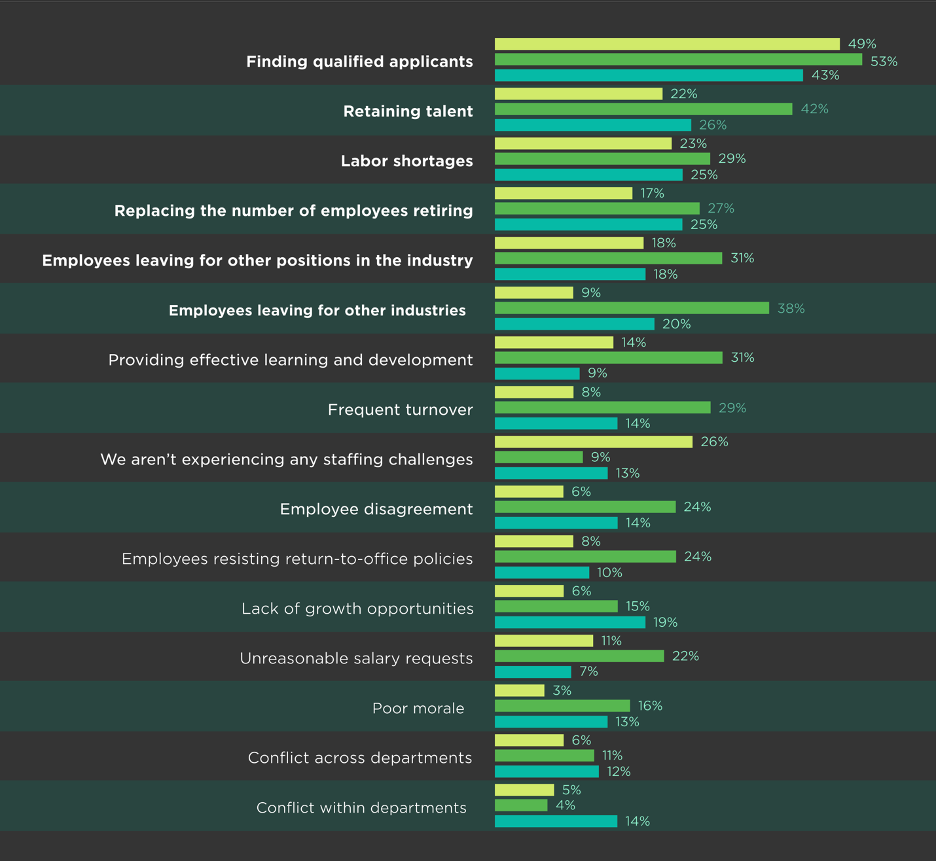
- 42% of Believers struggle to retain talent (22% for Achievers, 26% for Cynics).
- 31% of Believers find it difficult to provide effective learning and development (14% for Achievers, vs. 9% for Cynics).
- 31% of Believers lost employees for other positions within the industry (18% for Achievers and Cynics).
- 38% of Believers lost employees to other industries altogether (9% for Achievers, 20% for Cynics).
- 29% of Believers experienced frequent turnover (8% for Achievers, 14% for Cynics).
- 22% of Believers struggled with unreasonable salary requests (11% for Achievers, 7% for Cynics).
Let’s linger on that last point for a moment, as the use of the word “unreasonable” jumps out to me. Here we’re dealing with a group of people who are overworked, burning out, and hobbled by low budgets from management while also hemorrhaging talent whom they aren’t even able to train. This same group of people are three times more likely to consider a salary request “unreasonable” than even the Cynics.
More than anything, a report card like this indicates a dire need to come to terms with a failing culture. Decisions to fix your culture will have to start at the top as no amount of marketing polish is going to overcome leadership resistance.
However, if your leadership is onboard with overhauling the culture, then branding and marketing can play a huge role in turning the ship around. Low hanging fruit in this area includes:
- Overhaul your digital presence. If your website dates back to Internet 1.0, the signal it sends to potential recruits is that you don’t invest in yourself. Why would they believe you’d invest in them?
- Showcase your team. In a world dominated by fake images and artificial content, authenticity shines bright. Photograph your team and your facilities. Capture video of your people at work, or interview them at their jobs where they can showcase their expertise. (Seeing people happy at work will help recruit new talent, but it’s also a great broader marketing strategy—people like watching other people be good at their jobs.)
- Share your lived values. Most companies have value statements. Too many companies fail to live up to them. If you want incoming employees to believe yours are real, you have to show how your company practices those values in day-to-day life. If you treat your employees like family, are you the kind of family that demands a lot and praises little? Or are you the family that makes everyone feel valued and supports its members through the hard times?
The point is that recruitment and retention are a key facet of healthy growth for any business—but they’re only rarely considered a priority for marketing. Putting marketing resources toward these initiatives can help your company bring in the people you need to haul yourselves out of the mud and on to firm footing.
6. Avoid marketing quicksand.
It can be hard to read a list of things you should be doing if you already feel your resources are stretched too thin. Where are you supposed to find the time? Well, we have thoughts.
- Cut back on your oversight committee. The more people involved in any decision, the longer it will take to move work out the door. What’s more, most people don’t want to be involved in every decision. If you’re trying to get more involvement from Sales, don’t ask them to review every blog article and instead save your asks for key sales meetings. Keep your leadership team focused on your top level priorities, and save the content updates for a quarterly meeting where you can show them everything you accomplished.
- Don’t do things just because they’ve always been done. We talked earlier about not reporting on metrics you don’t influence. Similarly, drop marketing activities if they’re not working for you. SEO is a great example: How many of the SEO tasks that would have been considered essential ten years ago are even relevant today? We’d answer, but (again) that’s a whole new blog topic. The point is: Changing routines can be hard when you have the process nailed down. But best practices change, and your strategy needs to evolve with them before yesterday’s novel ideas become today’s bad habits.
- Move out of idea land. Coming up with grand content plans is exciting. Executing them is hard—especially once everything gets gummed up in endless iterations of feedback. Next thing you know, it’s reporting time again, and you have precious little to show for it… so you regress, oversharing numbers that don’t matter to buy time to execute the ideas in your strategy. A few rounds of this go by, and now you’re burnt out. Clearly your strategy was bad, but now you have ideas for a new one, and this one will surely work… and the cycle repeats itself.
Imagine if you implemented the above. Before, you were creating elaborate strategies that get bogged down in endless rounds of approval until the only tasks you can reliably finish are the ones no one has any investment in. Now, you’re gaining good will by reducing low-value demands on everyone else’s attention. Outdated tasks have been cleared to make room for relevant actions directed toward achievable, measurable outcomes.
Do less and achieve more.
Judging from the responses to our survey, many believers seem trapped under the toxic expectation that they can magically get more done with fewer resources. This will always be a downward spiral.
However, there is a lot to be said for stripping back to the essentials, focusing on the actions that will make the biggest difference for your business model, and rebuilding from the fundamentals. The basics don’t just work—they’re powerful. Get them pulling in your favor, and you won’t have to take it on faith.
Seeing is believing, after all.